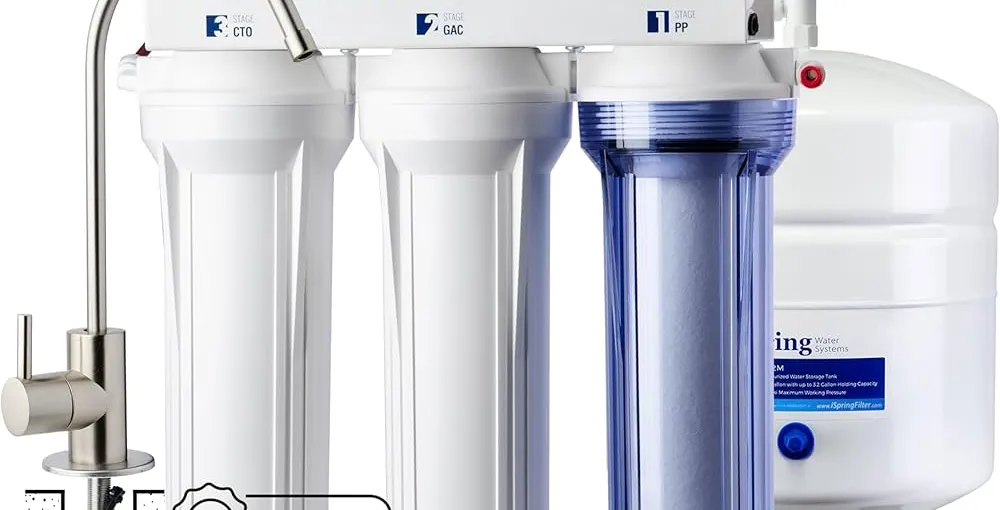
The Truth About Tap Water
Most municipal water contains traces of industrial runoff, pharmaceutical residue, and legacy infrastructure contaminants that pass right through standard carbon pitcher filters.
While local utility companies routinely celebrate meeting federal regulatory standards, there is a massive gap between “legally compliant” and “biologically optimal.” If you are investing in grass-fed meats and organic produce, utilizing standard tap water for drinking, cooking, and coffee extraction is a critical biological blind spot.
Here is why upgrading to a Reverse Osmosis (RO) system is a non-negotiable step for a bio-optimized environment.
The Illusion of “Safe” Tap Water
Standard municipal water treatment is designed to prevent acute, immediate diseases (like cholera or dysentery). It achieves this primarily through heavy chlorination. However, this outdated approach creates secondary issues while failing to address modern industrial pollutants.
- Disinfection Byproducts (DBPs): When chlorine interacts with naturally occurring organic matter in water, it forms DBPs, such as trihalomethanes (THMs). Peer-reviewed literature has consistently linked long-term exposure to DBPs with cellular damage and endocrine disruption.
- PFAS “Forever Chemicals”: Per- and polyfluoroalkyl substances (PFAS) are ubiquitous in American water systems. Standard carbon block filters (like the pitcher in your fridge) do not possess the micron-rating to effectively trap these compounds, allowing them to accumulate in human tissue.
- Heavy Metals: Even if water leaves the treatment plant clean, it must travel through miles of aging pipes. Micro-frictions slowly leach lead, copper, and arsenic directly into the residential supply.
Why Standard Filters Fail
The standard activated carbon filter—the kind found in most refrigerator doors and popular pour-through pitchers—operates on adsorption. It acts like a sponge, pulling chlorine out of the water to improve taste and odor.
However, carbon filters act as a sieve with holes that are simply too large. Dissolved heavy metals, fluoride, and synthetic chemicals flow right past the carbon media. Improving the taste of your water does not equal improving its purity.
The Reverse Osmosis Standard
Reverse Osmosis is the only consumer-accessible technology that effectively strips water down to its base molecular structure ($H_2O$).
Instead of just catching large particles, an RO system uses high pressure to force water through a semi-permeable membrane with pores as small as 0.0001 microns.
To put that in perspective, a human hair is about 70 microns across. The RO membrane is so microscopic that it physically blocks up to 99.9% of all dissolved solids, including:
- Fluoride
- Lead and Arsenic
- PFAS and Microplastics
- Pharmaceuticals
- Nitrates from agricultural runoff
The Biological Caveat: Remineralization
Because Reverse Osmosis is so brutally effective, it removes everything—including beneficial trace minerals like calcium and magnesium. Drinking “dead,” demineralized water long-term can actually leach minerals from your bones and teeth, as the water seeks to rebalance itself inside your body.
For a truly bio-optimized environment, an RO system must be paired with a remineralization phase.
The systems we curate and recommend on this platform all feature a final stage where the purified water passes through a bed of natural alkaline stones, reintroducing the exact electrolyte profile your cells need for optimal hydration, mimicking the profile of ancestral mountain spring water.
Academic References & Further Reading
For those who wish to dig into the primary literature, we recommend reviewing the following peer-reviewed studies regarding municipal water contaminants and filtration efficacy:
- On the ubiquity of PFAS: Andrews, D. Q., & Naidenko, O. V. (2020). Population-Wide Exposure to Per- and Polyfluoroalkyl Substances from Drinking Water in the United States. Environmental Science & Technology Letters.
- On Disinfection Byproducts (DBPs): Villanueva, C. M., et al. (2015). Health impact of disinfection by-products in safe drinking water. International Journal of Hygiene and Environmental Health.
- On Reverse Osmosis efficacy: Ning, R. Y. (2002). Arsenic removal by reverse osmosis. Desalination. (Demonstrating the necessity of high-pressure membrane filtration for heavy metal removal).
- On the necessity of Remineralization: World Health Organization (WHO). (2005). Health risks from drinking demineralised water. (Highlighting the biological requirement to reintroduce calcium and magnesium post-filtration).